Cellular Antenna Installation and Signal Improvement in Alberta
Cellular equipment is only as good as the signal reaching it, and the signal reaching it is mostly a function of where the antenna is and what stands between it and the tower. A router with excellent specifications sitting in a basement mechanical room will underperform a modest one fed by a correctly aimed antenna on the roof, every time.
This is the least glamorous part of a connectivity project and frequently the one that decides whether it succeeds. Modern buildings are effective radio barriers: foil-backed insulation, low-emissivity window coatings, steel cladding and concrete all attenuate cellular signal heavily. Rural sites face the opposite problem — nothing in the way, but a tower far enough off that only a directional antenna aimed properly will pull a workable signal from it.
We survey, install and aim cellular antennas across Alberta for fixed sites, remote installations and vehicles, and we measure signal quality before and after so the improvement is demonstrated rather than asserted.
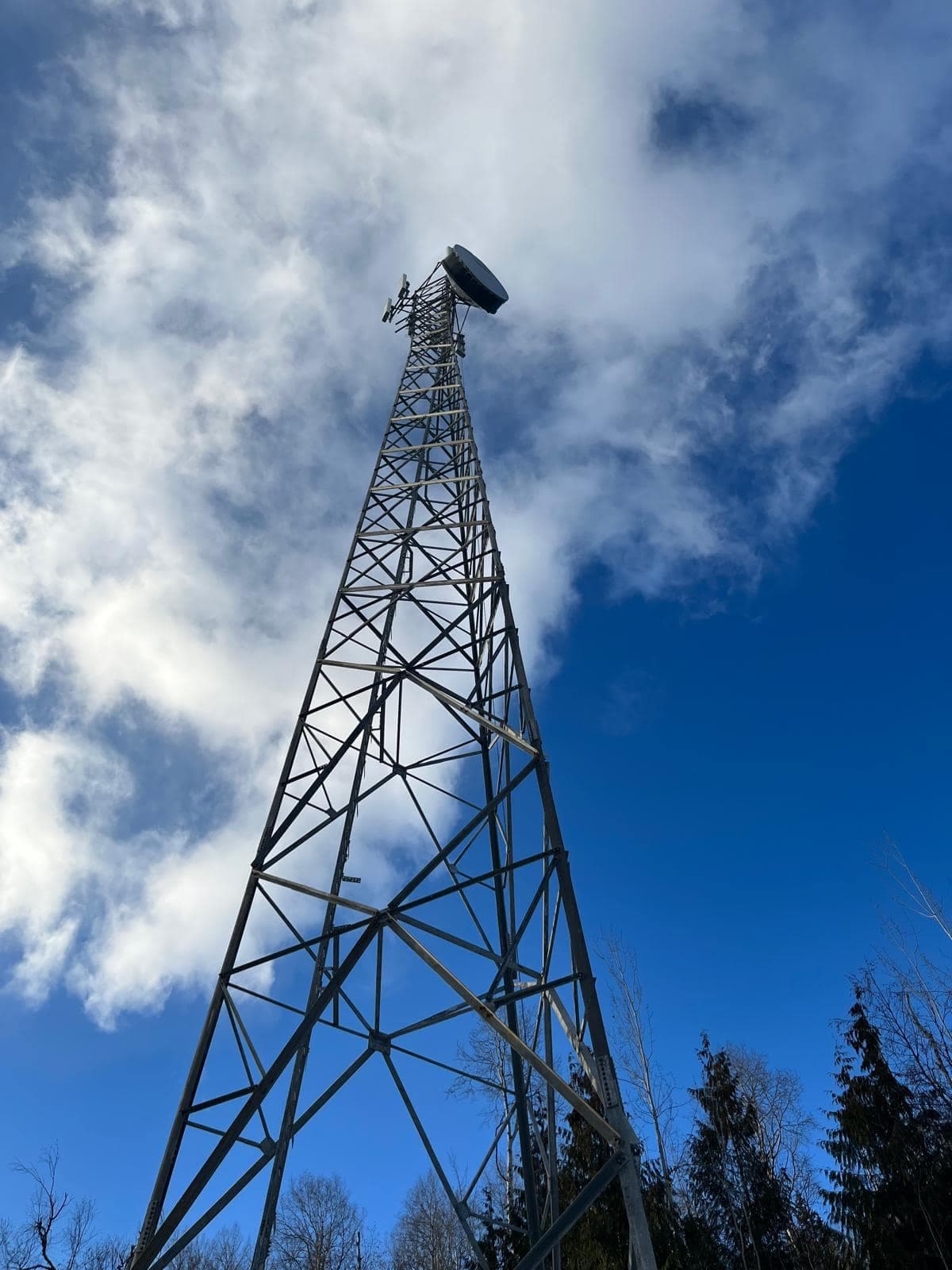
Our work
Photographs from our own installations, not stock images.
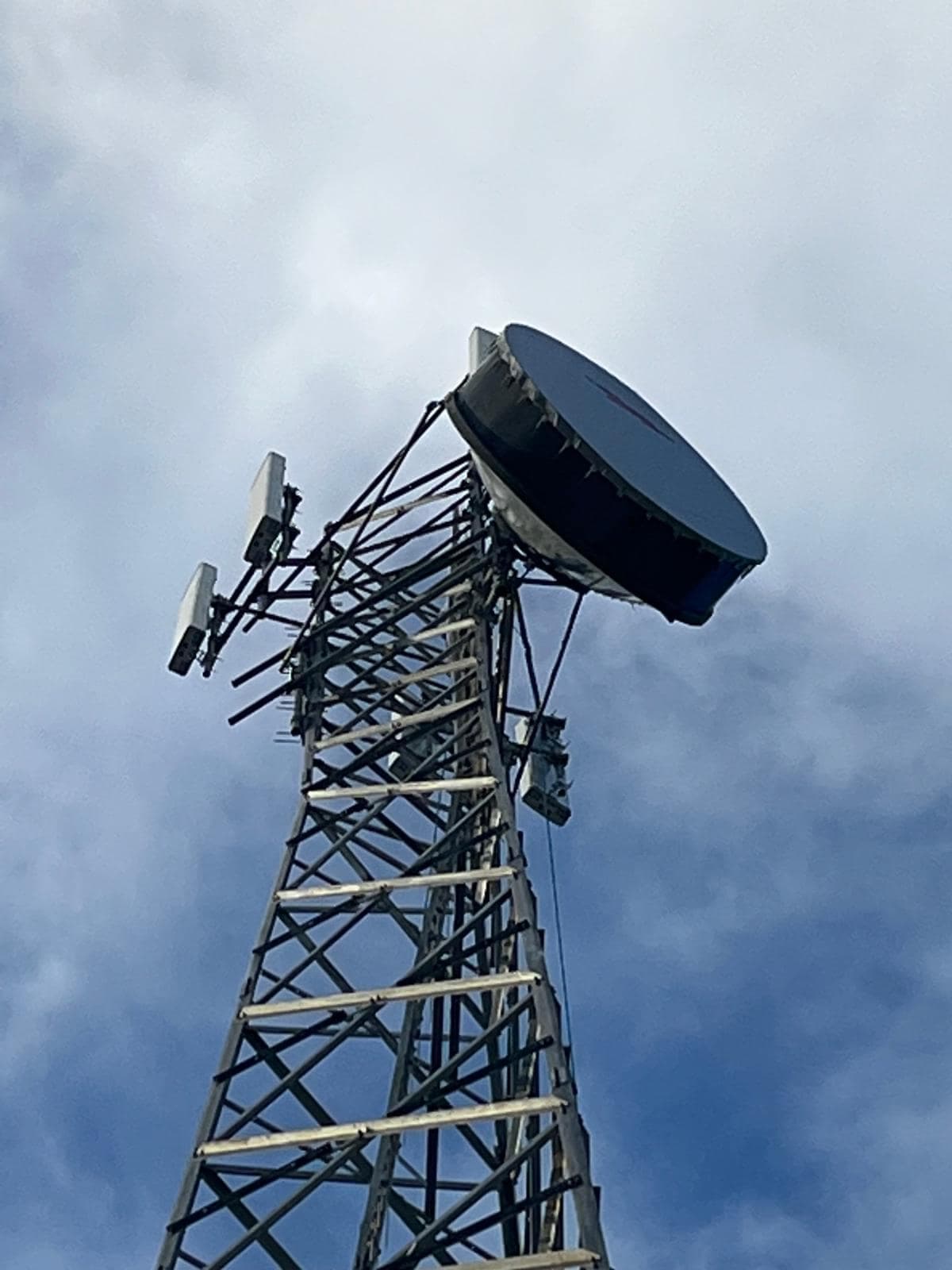
Microwave backhaul dish and sector antennas at the head of a lattice tower.
Who This Service Is For
The situations where this work is usually the right answer.
Rural properties far from a tower
Acreages, farms and remote homes where a directional antenna on a mast is the difference between no service and a working connection.
Buildings that block signal
Basements, steel-clad shops, concrete buildings and modern construction with foil-backed insulation and coated glass.
Cellular router and failover deployments
Sites running Cradlepoint or Peplink hardware where the stock antennas are the bottleneck rather than the router.
Vehicles and mobile equipment
Work trucks, mobile command units and specialty vehicles where a body-mounted antenna is required to get signal at all.
What the Installation Includes
Everything below is part of a standard engagement, not a list of chargeable extras.
- Signal survey measuring RSRP, RSRQ and SINR — not just bar count
- Identification of serving tower direction and usable frequency bands
- Testing of multiple candidate antenna positions before committing to one
- Antenna type selection: directional, omnidirectional or MIMO
- Mast, roof, wall, pole or vehicle mounting appropriate to the site
- Precise aiming on directional antennas, verified against live measurements
- Low-loss coaxial specified and kept as short as the run allows
- Weatherproofed connectors and sealed cable entry with drip loop
- Lightning arrestor and grounding on mast and roof installations
- Signal booster installation and gain configuration where appropriate
- MIMO pair separation and polarisation set for genuine spatial diversity
- Documented before-and-after measurements at the router
Our Process
How a project runs from first contact to handover.
Signal survey
We measure signal quality at several candidate positions and identify the serving tower direction and the bands actually available at your location.
Antenna and mount specification
Survey results determine directional versus omnidirectional, single versus MIMO, and the mounting height and structure required.
Mounting and cable routing
Mast or bracket fixed to structure, antenna mounted, and low-loss coaxial routed by the shortest practical path with sealed entry and drip loop.
Aiming and grounding
Directional antennas are aimed against live signal readings rather than by compass alone, and mast installations are grounded with a lightning arrestor fitted.
Verification
Final measurements are taken at the router and compared against the baseline, and throughput is tested so the gain is shown in practice.
Equipment We Support
- Directional Yagi and log-periodic antennas
- High-gain antennas aimed at a specific tower. The right answer for rural sites at distance, where concentrating gain in one direction beats listening everywhere.
- Omnidirectional antennas
- Used where the serving tower changes, on vehicles, and at sites where signal arrives from several directions or by reflection.
- MIMO antenna pairs
- Two elements with correct spacing and cross-polarisation so the modem can use both spatial streams, which typically matters more for throughput than raw gain.
- Masts, brackets and vehicle mounts
- Roof, wall, chimney, pole and tripod mounts, plus magnetic, NMO and through-hole mounts for vehicles, all rated for Alberta wind and ice loading.
- Signal boosters and low-loss coaxial
- Cellular repeaters for in-building coverage, with LMR-400 or better coaxial so hard-won gain is not lost in the cable run.
Where We Work
Cellular antenna work across Edmonton and the surrounding region, and at rural, remote and industrial sites throughout Alberta — which is where the difference between a stock antenna and a surveyed installation is largest.
See every area we serve across Alberta- Edmonton
- Sherwood Park
- St. Albert
- Spruce Grove
- Leduc
- Fort Saskatchewan
- Calgary
- Red Deer
- Grande Prairie
- Fort McMurray
Frequently Asked Questions
Common questions about cellular antenna installation in Edmonton and across Alberta.
Related Services
Work that commonly goes with this, and that we handle at the same time.
Cradlepoint Installation
Cradlepoint LTE and 5G routers installed and configured for automatic internet failover, remote sites and in-vehicle networks.
Cradlepoint InstallationPeplink Installation
Peplink multi-WAN routers installed to combine cellular, Starlink and wired circuits into one connection that survives any single link failing.
Peplink InstallationRemote Site Connectivity
Internet stood up where none exists — construction sites, camps, remote yards and unmanned installations, built to be deployed, moved and recovered.
Remote Site ConnectivityStarlink Installation
Obstruction surveys, secure mounting, weather-sealed cable entry and full network setup for Starlink dishes on homes, businesses and remote sites.
Starlink Installation
Request a Quote
Tell us about the site and what you need. We will come back to you with a straight answer about what the work involves and what it costs.