Professional Starlink Installation in Edmonton
We are based in Edmonton, so this is not a page written for a city we occasionally drive to. Most of our Starlink work happens inside the city and the ring of communities around it, and the installation decisions that matter here are specific enough that a generic approach produces mediocre results.
Edmonton presents three recurring problems. The mature neighbourhoods — Glenora, Ritchie, Highlands, Bonnie Doon, Westmount — have tree canopy tall enough that a ground-level or low roof position will clip the northern satellite arc even when the sky overhead looks completely open. The newer subdivisions on the south and southwest edges have the opposite issue: open sky but foil-backed insulation and low-emissivity windows that make the router's Wi-Fi performance considerably worse than the satellite link. And the river valley slopes create terrain shadowing on properties that otherwise look ideal.
The fourth factor applies everywhere in the city: our winter. Snow shedding off a pitched roof onto a badly placed dish, ice loading on a mount that was only specified for wind, and an unsealed cable entry that lets melt water track into a wall cavity are the three failures we are most often called out to correct — and all three are decided on installation day.
Our work
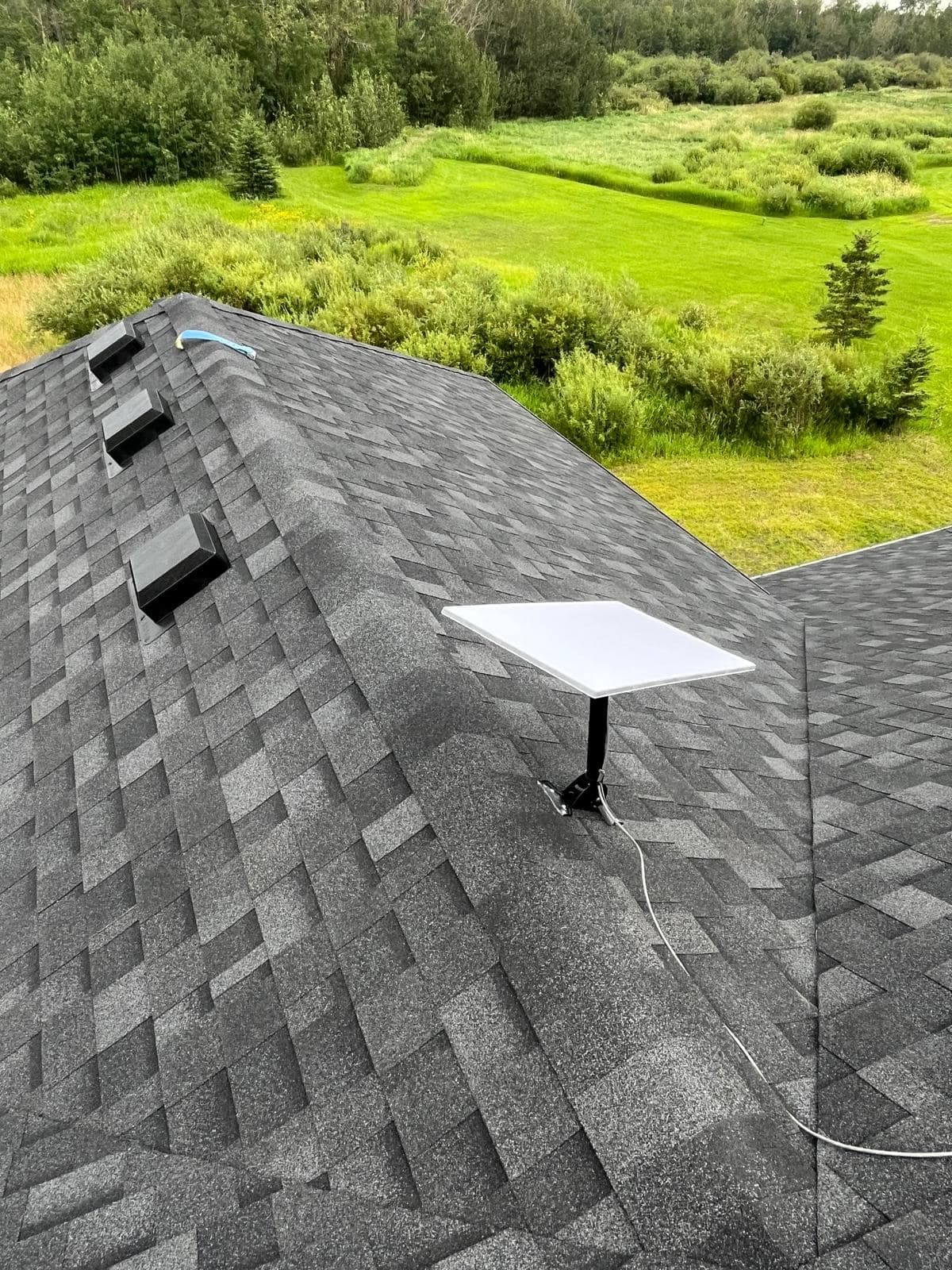
Photographs from our own installations, not stock images.
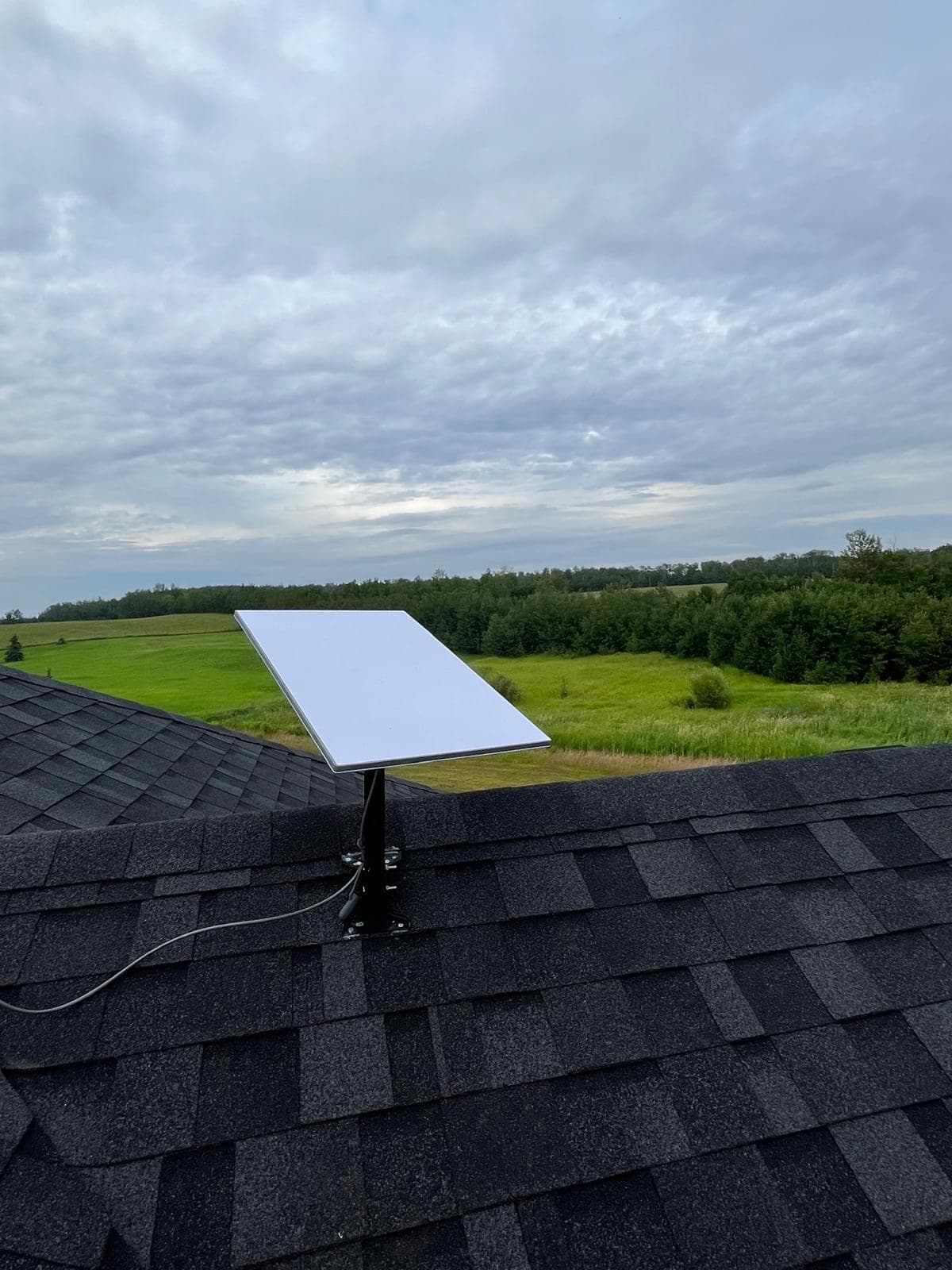
Ridge-mounted dish on an acreage property. The position was chosen to clear the treeline to the north rather than for the shortest cable run. 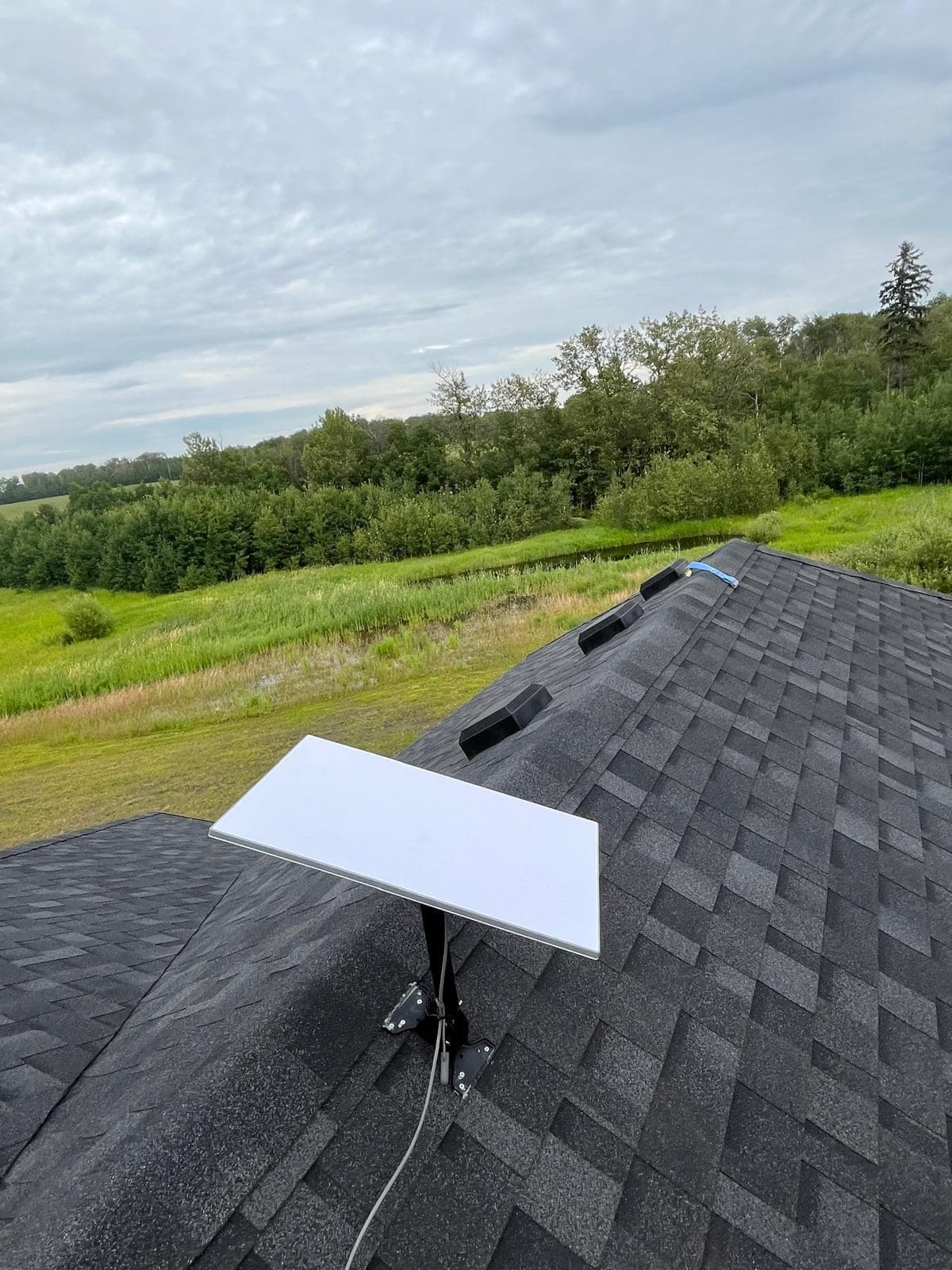
Ridge mount fixed through to structure, not sheathing. Positioned clear of the path snow takes when it sheds off the roof. 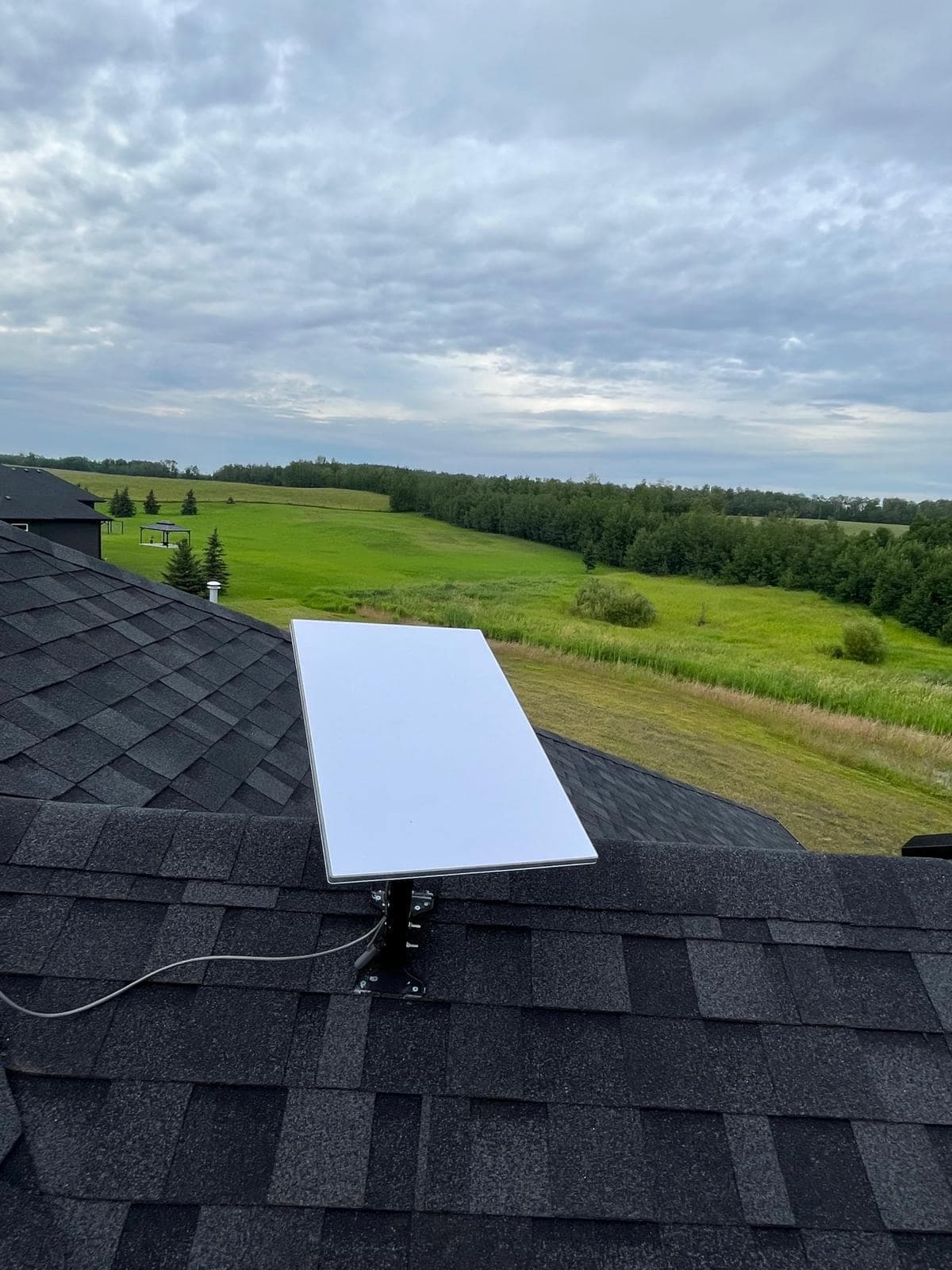
Completed acreage installation. Cable secured along the ridge line with UV-stable clips rather than left to sag.
Edmonton neighbourhoods and what they change
The right mount is a function of the property, not of a standard package. These are the patterns we see most often across the city.
- Mature neighbourhoods with tall canopy
- Glenora, Highlands, Westmount, Ritchie, Bonnie Doon, Garneau. Elms and spruce here regularly exceed the roofline. Height is usually driven by the tree line rather than the building, and a ridge or gable mount often is not enough — a mast or a position on the opposite side of the property does better. We survey against the full arc rather than assuming the highest point wins.
- Newer south and southwest subdivisions
- Windermere, Heritage Valley, Keswick, Glenridding, Walker, Laurel. Sky access is usually straightforward. The real problem is coverage: foil-backed sheathing, low-E glass and open-plan layouts over two storeys defeat the Starlink router well before the satellite link becomes the limitation.
- River valley and ravine properties
- Properties backing onto the North Saskatchewan valley or the ravine system. Rising ground and dense valley growth can shadow part of the arc from a position that looks completely clear at eye level. This is the case where a survey most often changes the plan.
- Infill and narrow lots
- Skinny homes and garden suites where the neighbouring roofline is close and tall. Mount position is constrained by the property line as much as by sightlines, and cable routing has to work around a very tight envelope.
- Condominiums and rented property
- Where you do not own the exterior envelope, a non-penetrating ballast mount on a flat roof or a balcony-mounted solution avoids drilling entirely. Written permission from the board or landlord comes first — we will tell you what to ask for.
Installing for an Edmonton winter
Edmonton runs colder for longer than most of the places Starlink installation advice is written for. The dish itself handles it — there is an integrated heater that clears the panel, and the hardware is rated well below what we reach. What fails is the installation around it.
So the winter decisions are made in advance: the dish goes outside the path of snow shedding off a pitched roof, the mount is specified for ice loading rather than wind alone, cable is routed with generous bend radii because it stiffens in deep cold, and the entry point is sealed with an exterior-grade product and a drip loop so meltwater runs away from the hole instead of into the wall.
- Dish positioned clear of roof snow-shed paths, which is the most common physical damage we see
- Mounts specified for ice loading, not only wind
- Generous cable bend radii — tight bends fracture after enough freeze-thaw cycling
- Exterior-rated sealant and a drip loop at every penetration
- Power headroom allowed for sustained heater draw through January and February
- Steeper dish angle where the site permits, so snow sheds instead of settling
Why Edmonton homes still have Wi-Fi problems after a Starlink install
This is the single most common follow-up call we get, and it catches people out because the satellite link is genuinely fine. The Starlink router is one access point with a modest footprint. In a two-storey Edmonton home with a finished basement, that is three floors for one radio to cover — and modern building materials work against it.
Foil-backed sheathing and low-emissivity window coatings are excellent insulators and effective radio barriers. In-floor heating, tile, and the steel used in newer construction all attenuate signal further. The fix is not a bigger router; it is putting the Starlink unit in bypass mode and feeding a properly placed access point layout. That is the work described on our Wi-Fi installation page, and we frequently do both in one visit.
Communities we cover from Edmonton
Same-day and next-day scheduling is realistic across the metro area because we are not travelling to get here. Beyond the city we cover the surrounding counties and the acreage belt, where Starlink is very often the only workable option at any price.
- Edmonton — all quadrants, including infill and condominium properties
- Sherwood Park and Strathcona County
- St. Albert, Morinville and Legal
- Spruce Grove, Stony Plain and Parkland County
- Leduc, Beaumont, Nisku and Leduc County
- Fort Saskatchewan, Gibbons, Bon Accord and Redwater
- Devon, Calmar and Thorsby
- Acreages throughout Sturgeon County and Lamont County
How the work runs
Obstruction survey
We check candidate positions against the full satellite arc — not just for open sky overhead — which in Edmonton usually means working out how far the mature canopy to the north actually reaches.
Mount and route agreement
Before anything is drilled we confirm the mount type, exact dish position, cable entry point and where the router will live. You approve it first.
Mounting and sealed cable entry
Fixed into structure rather than sheathing, positioned clear of roof snow-shed, with an exterior-rated seal and drip loop at the penetration.
Network setup and testing
Router configured and placed, then speed, latency, packet loss and the obstruction map verified and walked through with you before we leave.
Frequently Asked Questions
More on Starlink
The rest of the guide. Each page answers a different question.
Starlink Installation
The main guide — obstruction surveys, mounting, cable routing and network setup across Alberta.
Starlink installationCommercial & Business
Business-grade Starlink deployments integrated into a real network, with failover, documentation and support — not a residential dish on a commercial building.
Commercial & BusinessRural & Acreage
For acreages, farms and rural properties: wind-rated mounting, long cable runs, and coverage that reaches the shop and barn rather than stopping at the house.
Rural & AcreageMounting Options
Roof, pole, wall, ground and non-penetrating mounts compared honestly — including which ones we would not recommend and why.
Mounting OptionsCable Routing
Routing the cable properly: attic, basement and conduit routes, sealed entry points and drip loops that keep water out of your wall.
Cable RoutingStarlink Wi-Fi Setup
The dish gets you the connection; it does not get you coverage. Bypass mode, access point layouts and mesh done properly.
Starlink Wi-Fi SetupTroubleshooting & Repair
Diagnosing why a working Starlink stopped working — obstruction, cable, power or Wi-Fi. The three have completely different fixes.
Troubleshooting & RepairInstallation Cost
An honest breakdown of what drives installation price, what the Alberta market looks like, and where cheap quotes get expensive.
Installation Cost
Services That Go With This
The work customers most often need alongside a Starlink installation.
Wi-Fi Installation
Surveyed access point layouts that fix dead zones properly — for houses, offices, warehouses, metal shops and outdoor yards.
Wi-Fi InstallationStarlink Installation
Obstruction surveys, secure mounting, weather-sealed cable entry and full network setup for Starlink dishes on homes, businesses and remote sites.
Starlink Installation
Request a Quote
Tell us about the site and what you need. We will come back to you with a straight answer about what the work involves and what it costs.