Structured Cabling Installation in Edmonton and Alberta
Cabling is the part of a network nobody sees and everybody eventually pays for. It outlasts every switch, router and access point plugged into it, and it is the one layer that cannot be upgraded remotely. A site cabled properly once will carry three generations of equipment. A site cabled badly generates intermittent faults that get blamed on hardware for years.
Structured cabling means a planned system rather than individual runs: cable of a known category, run in a documented topology to a central point, terminated on patch panels, labelled at both ends, and certified with a tester that proves it meets specification. The result is that any port can be traced, moved or repurposed in minutes.
We install Cat6, Cat6A and fibre for offices, warehouses, retail sites, clinics, multi-tenant buildings and industrial facilities across the Edmonton region — new fit-outs, expansions, and remediation of cabling that was never done properly the first time.
Who This Service Is For
The situations where this work is usually the right answer.
New builds and tenant fit-outs
Spaces being built or renovated, where cable can be run in open walls and ceilings at a fraction of the cost of retrofitting later.
Offices expanding or reorganising
Sites adding desks, meeting rooms or floors where new drops need to match the existing scheme rather than start a new one.
Warehouses and industrial facilities
Long runs, high ceilings and harsh environments needing conduit, appropriate cable jackets and fibre where copper distance limits are exceeded.
Sites with undocumented legacy cabling
Buildings where nobody knows what terminates where, and every change means tracing cables by hand.
What the Installation Includes
Everything below is part of a standard engagement, not a list of chargeable extras.
- Cable route survey including pathways, firestop points and distance measurement
- Cat6, Cat6A or fibre selection based on required speed and run length
- Riser, plenum or outdoor-rated jacket selection appropriate to the pathway
- Cable pulled with tension and bend radius kept within specification
- Wall plates, keystone jacks and surface boxes at each work area outlet
- Termination to patch panels in a rack or wall-mount enclosure
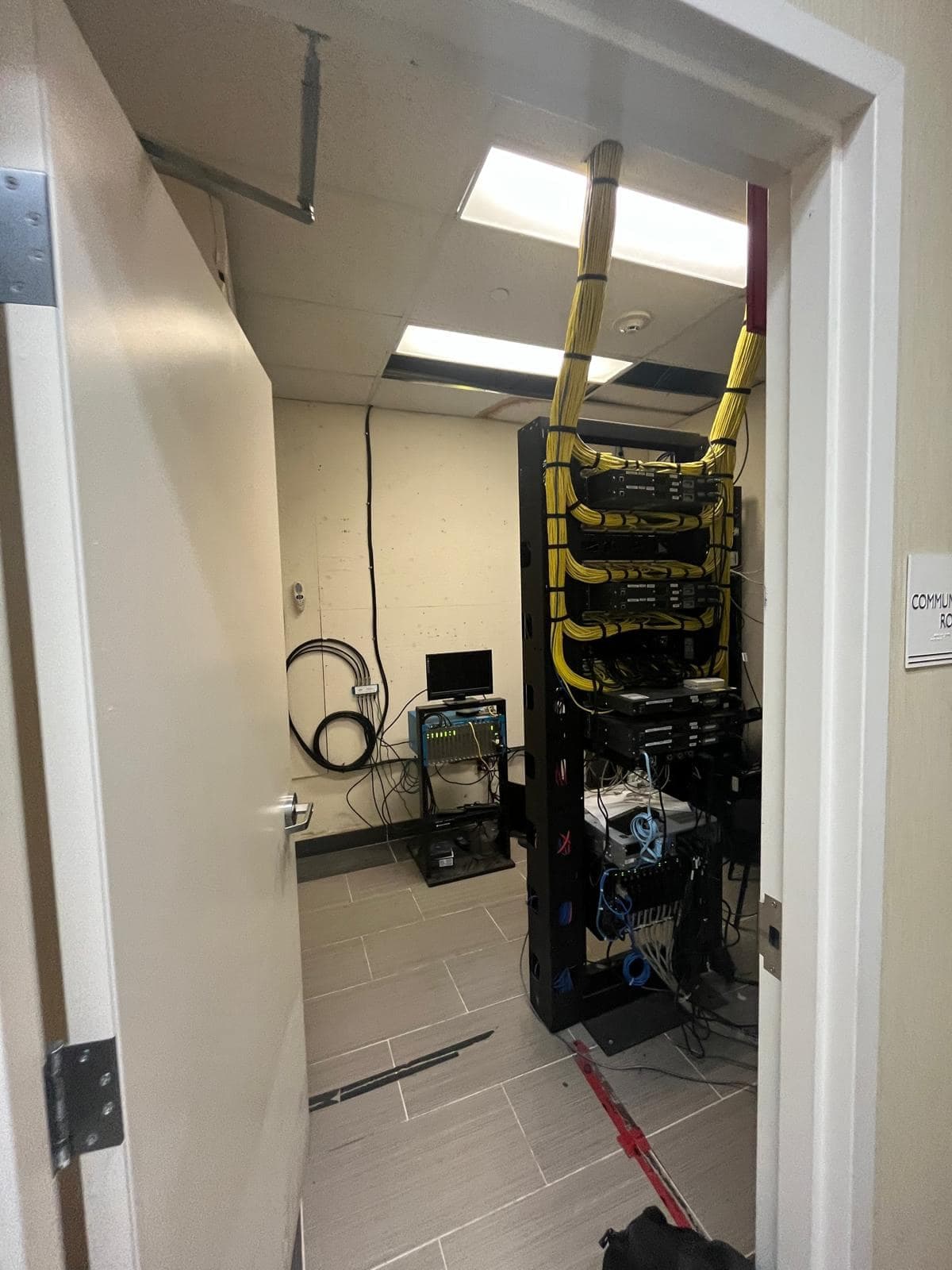
- Rack build-out with cable management, patch panels and clean cable dressing
- Fibre termination and splicing for backbone and long runs
- Certification testing of every run with results supplied to you
- Consistent labelling at outlet, cable and patch panel
- Firestopping at rated wall and floor penetrations
- As-built documentation with a port schedule mapping every outlet to its panel position
Our Process
How a project runs from first contact to handover.
Survey and cable schedule
We measure runs, identify pathways and penetrations, and produce a drop schedule listing every outlet, its location and its destination panel port.
Rough-in
Cable is pulled through ceilings, walls, conduit and trays, supported at proper intervals, and kept clear of power runs and interference sources.
Termination
Outlets and patch panels are terminated to the same standard throughout, and the rack is built out and dressed.
Testing and certification
Every run is tested for wire map, length, crosstalk and attenuation. Failures are corrected and retested — not left to become someone's intermittent fault.
Labelling and documentation
Both ends of every run are labelled to a consistent scheme, and you receive the port schedule, test results and as-built drawing.
Equipment We Support
- Cat6
- The practical default for most work-area drops, supporting 1 Gbps comfortably and 10 Gbps over shorter distances. Suitable for the large majority of office outlets.
- Cat6A
- Full 10 Gbps to 100 metres with better crosstalk performance. Worth the extra cost on backbone links, high-density access points and any run you do not want to revisit.
- Fibre optic (single-mode and multi-mode)
- Backbone between buildings, floors and distribution points, and anywhere copper's 100 metre limit is exceeded. Immune to electrical interference, which matters in industrial settings.
- Racks, patch panels and enclosures
- Floor and wall-mount racks, keystone and punch-down panels, horizontal and vertical cable management, and lockable enclosures where equipment is in a public area.
- Outdoor and direct-burial cable
- UV-stable and gel-filled cable in conduit for runs between buildings, with proper transition and protection at each entry point.
Where We Work
Structured cabling across Edmonton, Nisku, Leduc, Sherwood Park, St. Albert, Spruce Grove and Fort Saskatchewan, and to industrial and commercial sites throughout central and northern Alberta.
See every area we serve across Alberta- Edmonton
- Sherwood Park
- St. Albert
- Spruce Grove
- Leduc
- Fort Saskatchewan
- Calgary
- Red Deer
- Grande Prairie
- Fort McMurray
Frequently Asked Questions
Common questions about structured cabling in Edmonton and across Alberta.
Related Services
Work that commonly goes with this, and that we handle at the same time.
Commercial Network Installation
Designed and installed business networks: switching, routing, VLAN segmentation, firewalls, PoE and internet failover built to survive a working day.
Commercial Network InstallationWi-Fi Installation
Surveyed access point layouts that fix dead zones properly — for houses, offices, warehouses, metal shops and outdoor yards.
Wi-Fi InstallationIT Infrastructure Installation
Server rooms and equipment racks built properly: power, cooling, protection, cabling and documentation that outlast the hardware in them.
IT Infrastructure InstallationCellular Antenna Installation
Directional, omnidirectional and MIMO antenna installations that turn a marginal cellular signal into a usable connection — measured, not guessed.
Cellular Antenna Installation
Request a Quote
Tell us about the site and what you need. We will come back to you with a straight answer about what the work involves and what it costs.