Starlink Mounting Options: A Complete Guide
The mount is the decision that determines whether an installation still works properly in five years. It sets whether the dish clears obstructions, whether it survives ice loading, whether water gets into your wall, and whether anyone can safely service it later. Everything else about a Starlink installation is comparatively easy to change.
This page covers every mounting option we install, what each is genuinely good for, and — more usefully — where each one fails. There is no single best mount. There is a best mount for a specific building, a specific obstruction pattern and a specific level of exposure, and choosing it is what the site survey is for.
One principle worth stating before the detail: mount height should be set by what you need to clear, not by a preference for height. Once the satellite arc is clear, going higher adds cable loss, wind loading, structural demand and service difficulty while adding nothing to performance.
Our work
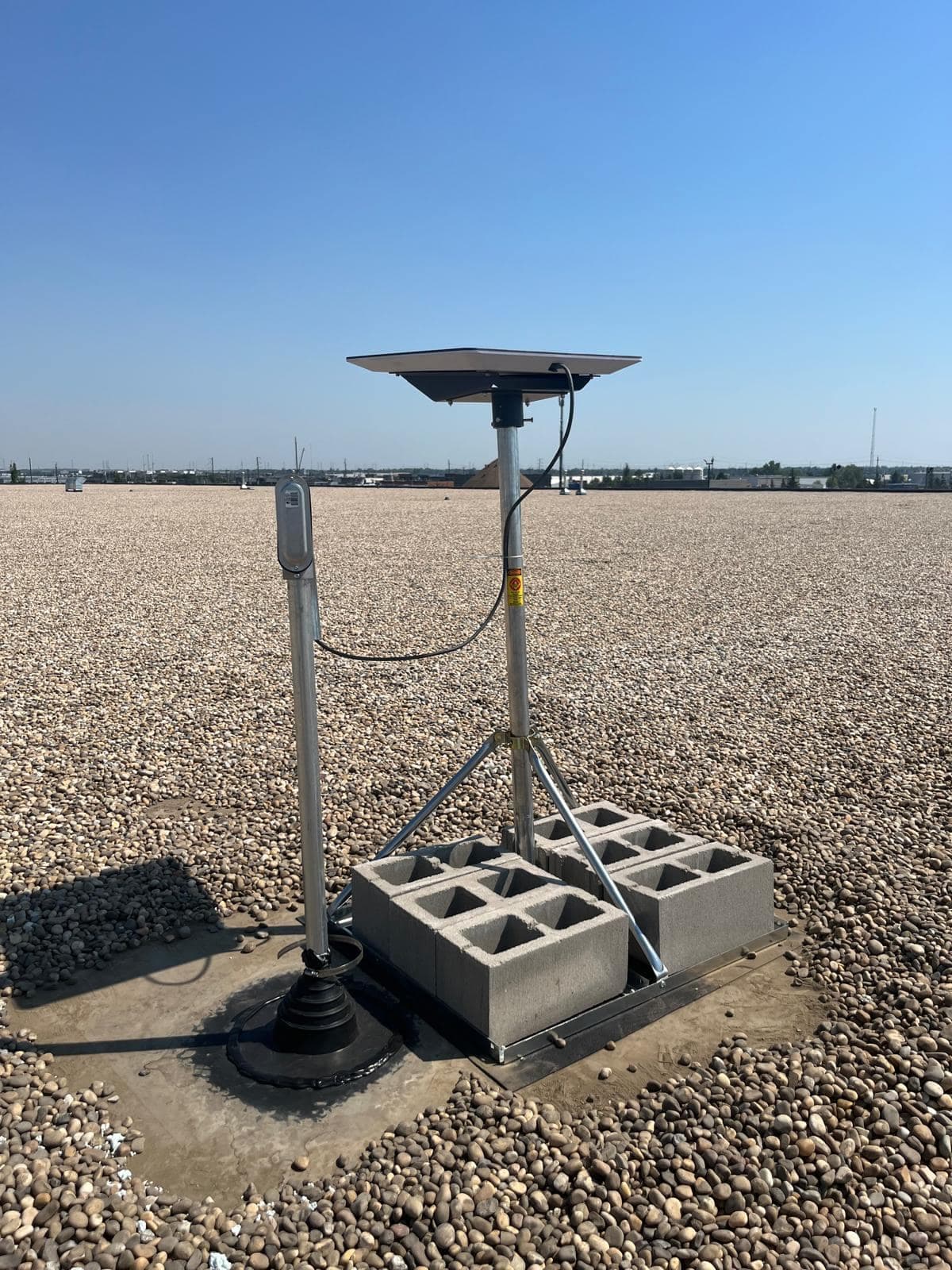
Photographs from our own installations, not stock images.
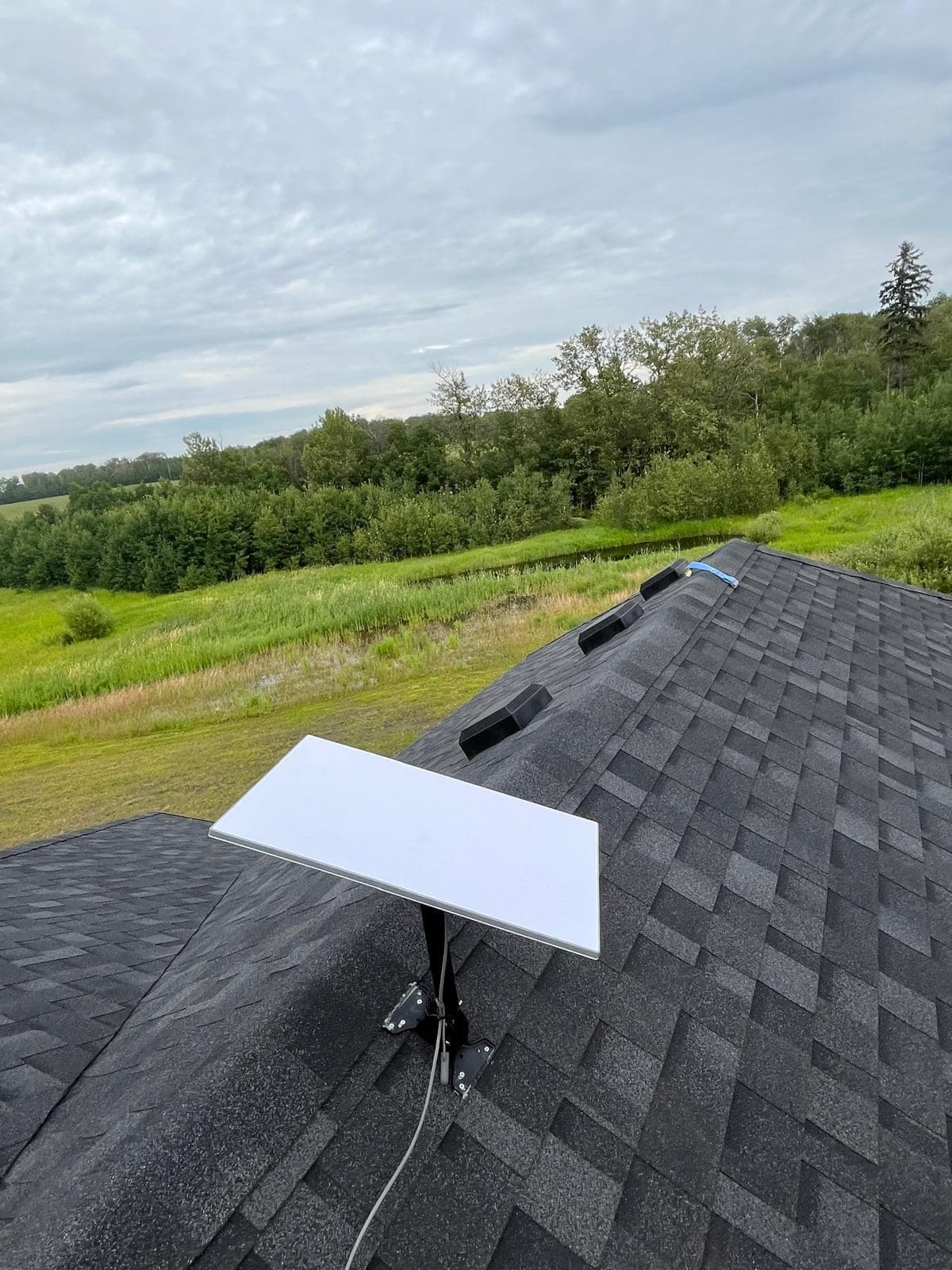
Ridge mount fixed through to structure, not sheathing. Positioned clear of the path snow takes when it sheds off the roof. 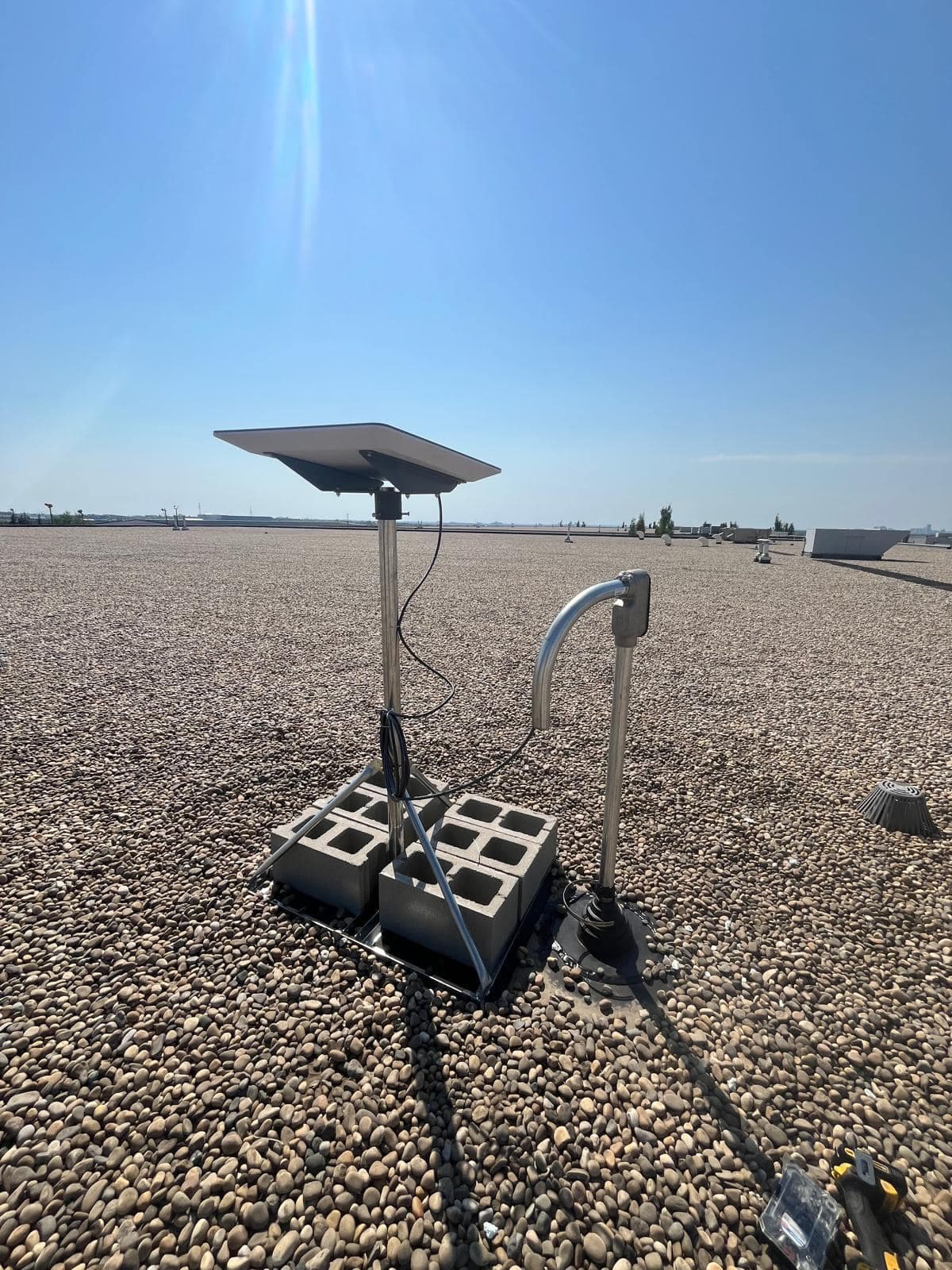
A weatherhead turns the conduit downward so water runs off rather than into the run. Ballast sized for the exposure this roof actually sees. 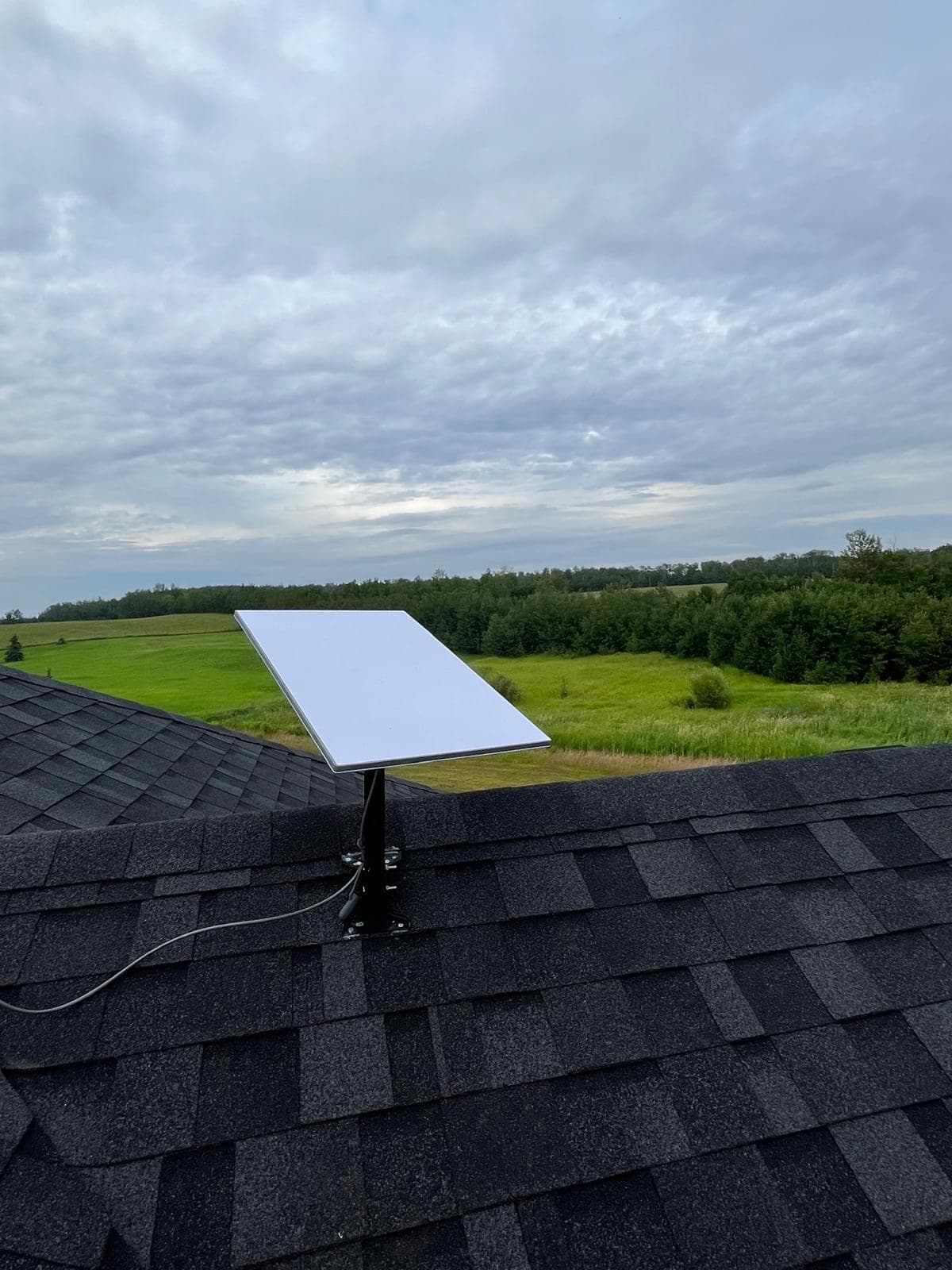
Ridge-mounted dish on an acreage property. The position was chosen to clear the treeline to the north rather than for the shortest cable run.
The mounting options compared
Listed roughly from most to least common in the work we do across Alberta.
- Pitched roof mount
- The most common residential answer. Fixed into rafters or structural members — never into sheathing or shingles alone — with a sealed, flashed penetration. Best for: clearing a moderate tree line with a short cable run. Watch for: snow shedding off the roof onto the dish, which is the physical damage we most often repair. The dish must sit outside the shed path, not merely on the roof.
- Non-penetrating ballast mount
- A weighted frame that sits on a flat roof and holds the dish by mass rather than by fixing. Best for: commercial flat roofs, condominiums, and anywhere a roof membrane warranty makes a penetration a financial risk. Watch for: ballast must be sized for the actual wind exposure, and an open prairie or upper-storey commercial roof needs considerably more than a sheltered specification.
- Pole mount, driven or concreted
- A pole set in the ground, away from the building. Best for: rural and acreage properties where the roof will not clear a shelterbelt, and any exposed site where the mount can be positioned for wind as well as sightlines. Watch for: depth, diameter and bracing must match open-field loading. This is where undersized hardware fails first.
- Wall and fascia mount
- Bracket fixed to an exterior wall or fascia board. Best for: a short, tidy install where the obstruction is modest and the wall faces the right way. Watch for: fascia board is often not structural — fixing must reach a rafter tail or blocking behind it. A fascia-only fixing will eventually work loose or pull through.
- Ground mount
- The dish at or near ground level on a base or short post. Best for: properties with genuinely open sky and no obstruction, and the easiest option to service. Watch for: snow accumulation in an Alberta winter, and vulnerability to being knocked, mown into or disturbed by livestock and equipment.
- Chimney mount
- Strapped to a chimney stack. Best for: occasionally the only position with height and clear sky. Watch for: we frequently advise against it. Many older chimneys are not structurally sound enough for sustained wind loading, and mortar condition is hard to assess from the ground. We will assess it, and will tell you when the answer is no.
- Existing mast or antenna tower
- Reusing a mast left from a previous fixed-wireless or TV antenna installation. Best for: rural properties, and often the cheapest good answer available. Watch for: guy wires, corrosion and footing condition all need checking. We assess it honestly rather than defaulting to selling new hardware.
- Metal roof clamp and seam mount
- Hardware that grips a standing seam or roof profile without penetrating the panel. Best for: metal-clad shops and modern metal roofs where a fastener through the panel is an invitation to a leak. Watch for: the profile has to suit clamp hardware; where it does not, a properly gasketed fastener is the alternative.
Mounting the Starlink Mini differently from Standard and Gen 4
The Mini is built around a different assumption than the Standard and Gen 4 dishes — that it might move — and that changes what a good permanent mount looks like. Its integrated kickstand is designed for a quick, temporary set-down, not for a fixed installation exposed to Alberta wind and ice for years.
For a permanent Mini installation we replace the kickstand with a fixed mounting adapter and treat it the same way we would any other dish: rafters or structural fixing, never sheathing alone, sealed cable entry and a position clear of roof snow-shed. The Mini's smaller size makes it a genuinely good option for a wall or fascia mount where a full-size dish would be visually heavy, and its lower power draw is worth factoring in on an off-grid or solar-powered property.
Can Starlink be installed without drilling into the wall?
Frequently, yes — and it is one of the most common things people ask us. There are two separate questions hiding in it: whether the mount requires a penetration, and whether the cable does.
For the mount, non-penetrating ballast frames, ground mounts, pole mounts away from the building and clamp-based fixings all avoid making a hole in the structure entirely. For the cable, an existing service penetration, a soffit or vent route, a window-frame pass-through, or routing through an unfinished basement rim joist can often get the cable inside without a new hole in a finished wall.
Where you are renting, in a condominium, or simply do not want holes in your home, say so at the assessment. It genuinely changes the recommendation, and there is almost always a workable answer.
- Non-penetrating ballast mount on a flat roof
- Free-standing pole or ground mount away from the building
- Clamp or seam mounts on metal roofing
- Cable through an existing service penetration or vent
- Cable through a soffit into an attic and down an interior cavity
- Basement rim-joist entry where the basement is unfinished
What Alberta weather demands of a mount
Most mounting guidance is written for milder places, and it under-specifies for here. Three factors matter more in this province than the hardware documentation implies.
Ice loading adds weight and surface area that wind-only calculations miss, so hardware adequate in October can work loose by February. Freeze-thaw cycling — which Calgary and the foothills get repeatedly through chinooks — steadily loosens fasteners that were correctly torqued on the day. And snow shedding from a pitched roof carries genuine force; a dish in that path will be moved or damaged, not merely dusted.
- Specify for ice loading, not wind alone
- Position clear of any roof snow-shed path
- Use fasteners and locking hardware that tolerate freeze-thaw cycling
- Steeper dish angle where the site allows, so snow sheds rather than settling
- Stainless or properly galvanised hardware — road salt and moisture find everything else
- Ground and bond any mast, and fit a lightning arrestor in the cable path
How we choose the mount for your property
The order matters. Obstruction clearance comes first, because a beautifully executed mount in the wrong position is still the wrong installation. Then structural suitability, then cable route, then exposure, and only then cost and appearance.
In practice we identify two or three candidate positions during the survey, check each against the obstruction map, and recommend the one that clears the arc with the shortest safe cable run and the least intrusive fixing. If two options are close, we will tell you the trade-off rather than deciding it for you.
Frequently Asked Questions
More on Starlink
The rest of the guide. Each page answers a different question.
Starlink Installation
The main guide — obstruction surveys, mounting, cable routing and network setup across Alberta.
Starlink installationEdmonton
Edmonton-specific Starlink installation: mature canopy obstruction surveys, snow-shed-aware mounting and sealed cable entry for our climate.
EdmontonCommercial & Business
Business-grade Starlink deployments integrated into a real network, with failover, documentation and support — not a residential dish on a commercial building.
Commercial & BusinessRural & Acreage
For acreages, farms and rural properties: wind-rated mounting, long cable runs, and coverage that reaches the shop and barn rather than stopping at the house.
Rural & AcreageCable Routing
Routing the cable properly: attic, basement and conduit routes, sealed entry points and drip loops that keep water out of your wall.
Cable RoutingStarlink Wi-Fi Setup
The dish gets you the connection; it does not get you coverage. Bypass mode, access point layouts and mesh done properly.
Starlink Wi-Fi SetupTroubleshooting & Repair
Diagnosing why a working Starlink stopped working — obstruction, cable, power or Wi-Fi. The three have completely different fixes.
Troubleshooting & RepairInstallation Cost
An honest breakdown of what drives installation price, what the Alberta market looks like, and where cheap quotes get expensive.
Installation Cost
Services That Go With This
The work customers most often need alongside a Starlink installation.
Request a Quote
Tell us about the site and what you need. We will come back to you with a straight answer about what the work involves and what it costs.