Does Starlink Work During Alberta Winters?
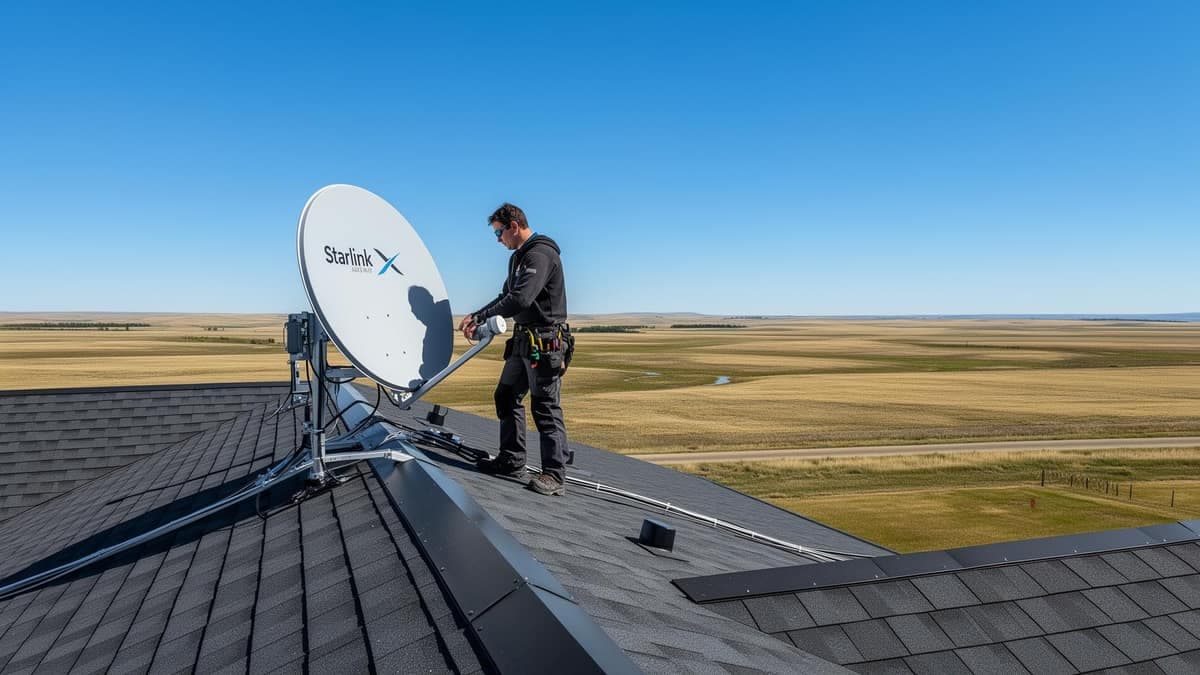
The hardware is built for it
Starlink dishes include an integrated heating element that melts snow and ice off the panel surface, and the units are rated to operate well below the temperatures Alberta reaches in a normal winter. In terms of the equipment itself, cold is a solved problem.
What is worth understanding is that the heater is not free. When it runs, the unit draws considerably more power than it does in mild conditions, and on sites running from generators, solar or battery backup that difference has to be provisioned for rather than discovered in January.
What actually fails in the cold
In practice, winter problems are almost never electronic. They are mechanical, and they trace back to how the installation was done.
Cable is the most frequent culprit. Standard cable stiffens as temperatures drop, and a cable that was bent tightly at installation can develop a fracture in the conductor or shielding once it has cycled through enough freeze-thaw. The resulting fault is intermittent and temperature-dependent, which makes it genuinely difficult to diagnose if you are not looking for it.
Sealant is the second. A cable entry sealed with an interior-grade product, or sealed without a drip loop, will eventually let melt water track along the cable and into the wall cavity. That is a building problem rather than an internet problem, and a considerably more expensive one.
Third is the mount. Ice adds load that wind alone does not, and hardware that was marginal in October works loose by February. Snow shedding from a roof onto a dish mounted below its path is the other mechanical failure we are regularly called to correct.
- Cable fracture from tight bends and freeze-thaw cycling
- Failed or inappropriate sealant at the entry point
- Fasteners working loose under ice loading and thermal movement
- Physical damage from snow shedding off a roof
Snow on the dish
The heater keeps the panel clear during normal snowfall. During heavy, wet snow it can occasionally accumulate faster than the heater clears it, which causes a temporary degradation that resolves on its own.
It is worth saying plainly: do not clear the panel with anything abrasive, and do not use hot water. The surface scratches, and thermal shock is a real risk. If snow does build up, the heater will deal with it. Mounting the dish at a steeper angle where the site allows also helps, since snow sheds rather than settling.
Does cold affect speed?
Not directly in any way users notice. Temperature does not meaningfully change the link between the dish and the satellite. What does affect performance in winter is weather in the signal path — heavy snowfall and dense cloud cause some attenuation, in the same way heavy rain does elsewhere.
The effect is usually modest and short-lived. Persistent slow performance through winter is far more likely to be an obstruction problem that was always present and is simply more noticeable, or one of the mechanical faults above, than a consequence of the temperature.
Getting the installation right the first time
Almost everything that goes wrong in winter is decided at installation. Cable rated and routed for cold, generous bend radii, an exterior-grade seal with a drip loop, mounting fixed to structure and specified for ice as well as wind, and a dish positioned clear of anything that sheds snow.
None of that is expensive to do at the time. All of it is expensive to correct in February, which is generally when it announces itself.