Where Should a Starlink Dish Be Mounted?
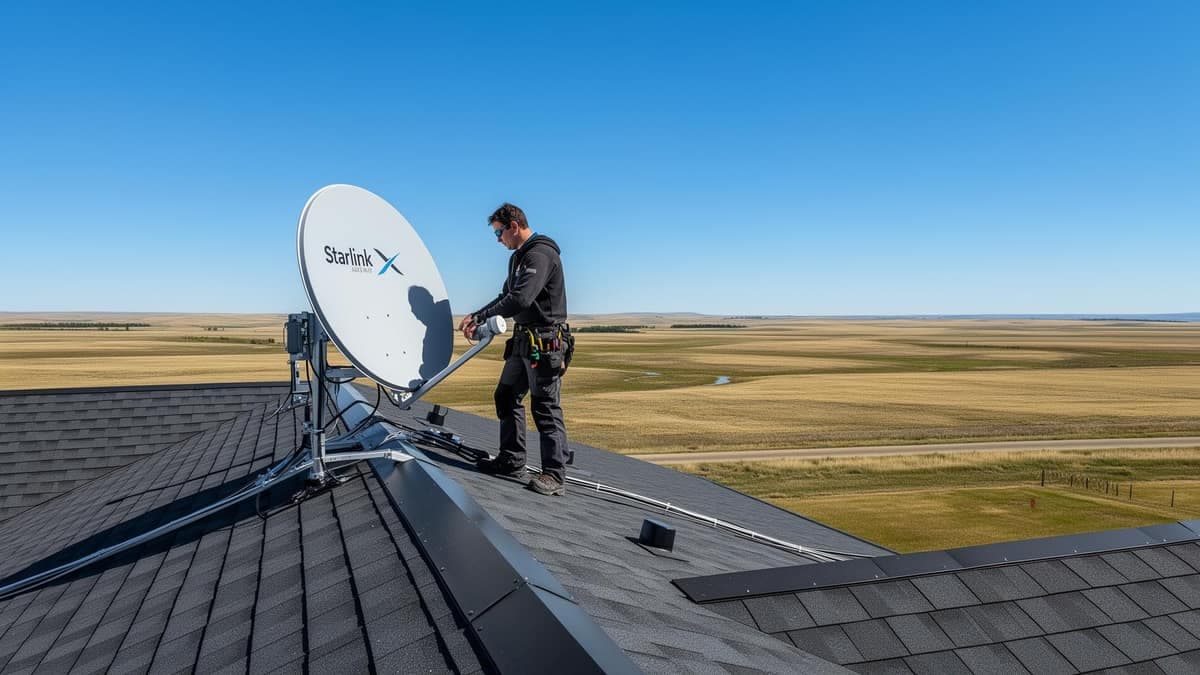
The dish needs a clear view of an arc, not of the sky above it
This is the single most misunderstood part of Starlink installation. People look straight up, see open sky, and conclude the position is fine. But the dish does not talk to a satellite parked overhead — it tracks satellites moving across a broad section of sky, and in Alberta a significant share of those passes sit relatively low toward the north.
That means a tree line, a neighbouring roof or a hill that is nowhere near directly overhead can still interrupt service. And because each interruption lasts only seconds, the symptom is not an obvious outage. It is a video call that stutters, a game that disconnects, or a file upload that fails partway — while a speed test run at the wrong moment reports everything as fine.
The Starlink app can map obstructions from a given position, and that map is the thing worth trusting. A position that looks unpromising and maps clean will outperform one that looks open and clips the arc.
Height helps only when it clears something
There is a widespread assumption that higher is always better. It is not. Height is useful precisely insofar as it gets the dish above whatever is blocking the path — a tree line, a roof ridge, a neighbouring building. Once the arc is clear, additional height adds nothing to performance.
What it does add is cost and risk: longer cable runs, greater wind loading, a more demanding mount, and harder access for any future service. A dish mounted two metres up with a clear arc is a better installation than one on a mast that was raised past the point of usefulness.
- Clear the obstruction, then stop climbing
- Longer cable runs mean more signal loss and a harder future service visit
- Higher mounts carry more wind load and need heavier fixing
- Anything you cannot safely reach again is harder to maintain
Roof, pole, or ground
Roof mounts are the most common because they usually clear obstructions with the shortest cable run. They require fixing into rafters or structural members — not into sheathing or shingles alone — and a properly sealed penetration with a drip loop.
Pole and mast mounts suit properties where the roof will not clear a tree line, or where a customer would rather not penetrate the roof at all. On exposed rural sites a braced pole away from the building is frequently the better answer regardless, because it can be sited for wind as well as for sightlines.
Ground mounts are the simplest option where the property has open space with no obstruction. They are easy to service and involve no work at height. The limitations are snow accumulation in winter and the fact that anything at ground level is easier to disturb.
What Alberta winter changes
The dish has a heater that clears snow and ice from the panel, so the panel itself is generally not the problem. The winter failures we see are mechanical and they are almost always set up at installation time.
The most common is snow and ice sliding off a roof onto a dish mounted in its path — enough force to shift alignment or damage the unit outright. The second is ice loading on a mount that was adequate for wind alone. The third, and the most damaging to the building, is a cable entry that was never sealed properly, where melt water tracks along the cable and into the wall.
- Keep the dish out of the path of snow shedding from a roof
- Specify mounts for ice loading, not only for wind
- Seal the cable entry and leave a drip loop below it
- Allow power headroom — the heater draws meaningfully when it runs
Deciding whether to do it yourself
Plenty of Starlink installations are genuinely straightforward. If the dish can sit at ground level with a clear arc, and the cable reaches an existing opening, self-installation is a reasonable afternoon's work and there is no need to pay anyone.
It is worth bringing someone in when the position requires work at height, when the cable has to pass through the building envelope, when obstructions make the right position non-obvious, or when an existing installation is dropping out and the cause is unclear. That last case is the most common reason we get called: the hardware is fine, and the position was chosen for convenience rather than from the obstruction map.