Starlink or Cellular Internet for a Rural Alberta Property?
The short version
Starlink generally delivers more throughput and works where no cell tower is reachable, but needs a clear view of the sky and has brief obstruction interruptions. Cellular is steadier where coverage exists, has lower latency, and needs no sky view — but at distance it requires a mast and a directional antenna to be usable at all, and its capacity varies with how many other people are on the same tower.
For a property that genuinely depends on the connection, the answer is frequently both, bonded together. They fail for completely unrelated reasons, which is what makes the combination more reliable than either alone.
What to check before you decide
Two measurements settle most of this, and both can be done before you spend anything.
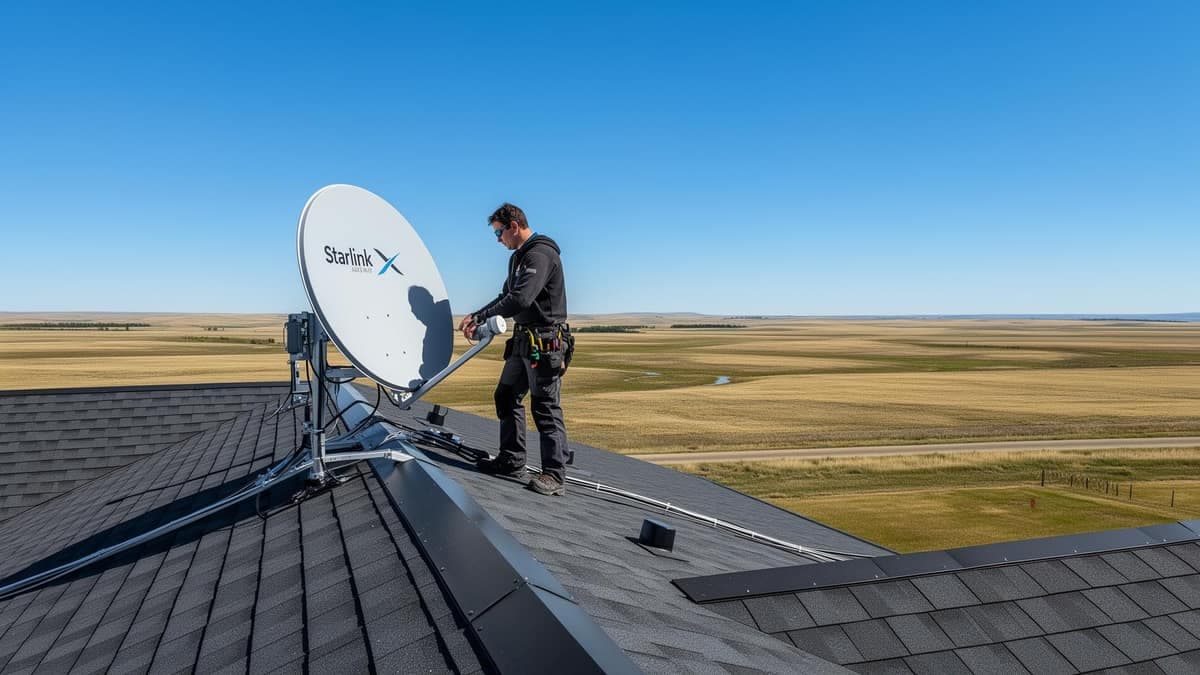
First, stand where the dish would go and look at the northern sky. Starlink needs a clear view of a broad arc, not just of the space overhead, and in Alberta a meaningful share of satellite passes sit relatively low toward the north. A shelterbelt or a tree line in that direction is the single most common reason a rural Starlink install disappoints.
Second, check actual cellular signal at the property — and not by looking at bars on a phone standing in the kitchen. Signal at roof height on the side of the building facing the tower is frequently far better than signal indoors, and that difference is exactly what an external antenna captures. If a phone gets nothing anywhere on the property, cellular is likely out. If it gets a weak but present signal outdoors, a mast and directional antenna may well make it viable.
- Clear view of the northern sky, from where the dish would actually go
- Cellular signal measured outdoors and at height, not indoors on a phone
- Distance to the nearest tower, and which carriers reach you at all
- Whether a fixed-wireless provider has line of sight to your property
- How much an outage genuinely costs you — this drives whether redundancy is worth it
Where Starlink wins
Raw capacity, and independence from local infrastructure. Starlink does not care how far you are from a town, whether a tower is congested at 8pm, or whether a fibre build was ever going to reach you. For a household streaming, working from home and running a few devices, it usually delivers a comfortably better experience than cellular at the same site.
It also scales to places nothing else does. A property with no cellular coverage whatsoever is not an edge case in this province, and Starlink is frequently the only option at any price.
Where cellular wins
Consistency and latency, where coverage is decent. A cellular link with a properly mounted external antenna does not have obstruction dropouts, which matters more than headline speed for video calls and remote desktop work. Latency is typically lower too.
It is also more forgiving physically. There is no requirement for a clear sky view, so a property under heavy canopy that cannot make Starlink work may still get a solid cellular link from an antenna on a mast pointed at a tower.
The catch is capacity. Cellular performance varies with tower congestion, so a link that tests well at 2pm on a Tuesday can be noticeably worse on a weekend evening. Data plans also cost more per gigabyte, which matters if the household streams heavily.
Why bonding both is often the right answer
This is the part most comparisons skip. Starlink and cellular do not fail at the same times or for the same reasons — Starlink drops on obstruction and severe weather, cellular degrades on congestion and distance. Combined through a router that can use both at once, the gaps in one are covered by the other.
With simple failover, the connection switches over when the primary drops, which costs you a few seconds and drops any live call. With bonding — Peplink's SpeedFusion being the common implementation — traffic runs across both simultaneously inside one tunnel, so a Starlink obstruction event does not interrupt an active session at all.
Whether that is worth the extra hardware and the second data plan depends entirely on what the connection carries. For a household, usually not. For a home business, a farm operation with monitoring obligations, or anyone doing live video work from a rural property, frequently yes.
A practical decision guide
If you have clear northern sky and no usable cellular: Starlink, and the decision is made for you.
If you have heavy canopy but reachable cellular: a cellular router with an external antenna on a mast, which will outperform a Starlink dish that cannot see the arc.
If you have both available and the connection is for a household: start with Starlink alone. It is simpler and usually cheaper per gigabyte.
If you have both available and the connection carries a business, monitoring, or work you cannot lose: both, bonded. The second path costs less than the downtime it prevents.