Do You Need Structured Cabling, or Is Wi-Fi Enough?
Why this gets framed as a choice when it rarely is one
A new business fitting out a space often asks whether they can skip the cabling project and just run everything on Wi-Fi. It is a reasonable question — Wi-Fi has genuinely improved, and nobody wants to pay for infrastructure they do not need. But the honest answer in most commercial spaces is that Wi-Fi itself depends on cabling to work well, which makes this less a choice between two options and more a question of how much wired infrastructure a good wireless network actually needs behind it.
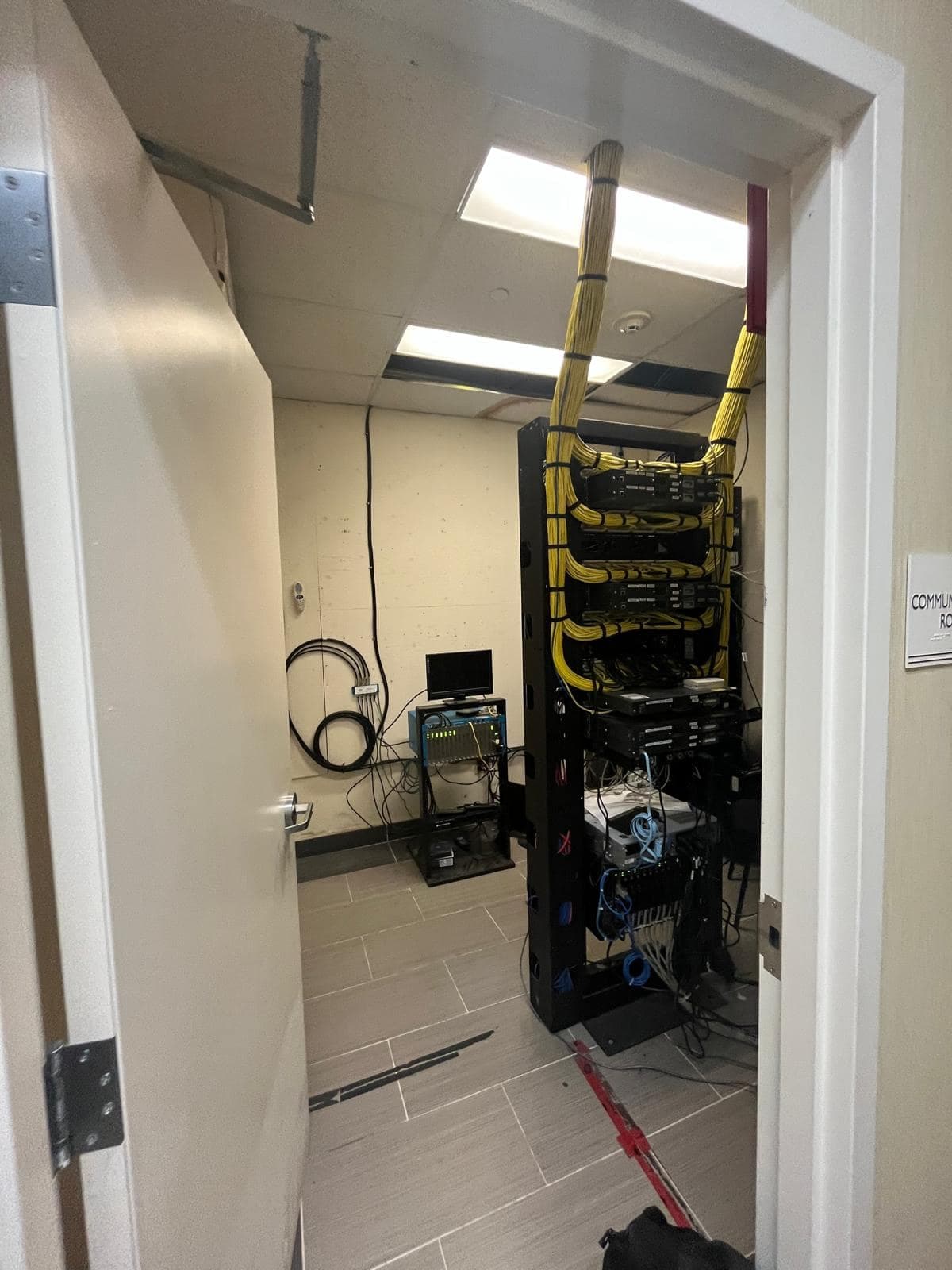
Every access point needs a wired connection back to a switch — Wi-Fi does not eliminate cabling, it changes where the cable terminates. A single access point plugged into a single data point covers a single room adequately. A building needing coverage throughout needs several access points, and each one needs its own cable run. That is a structured cabling project whether anyone calls it one or not.
Where Wi-Fi alone is genuinely enough
Small, single-level spaces with modest device counts and no fixed equipment that benefits from a dedicated wired connection — a small office, a retail counter, a compact café — can run well on a handful of properly placed access points fed by a correspondingly small amount of cabling. The space does not need a structured cabling project in the full sense; it needs a few good cable runs and competent access point placement.
Where wired connections still matter, even with excellent Wi-Fi
Fixed equipment that stays in one place and needs reliable, consistent bandwidth is the clearest case. Point-of-sale terminals, security cameras, printers, and any device running something time-sensitive are better served by a wired connection — not because Wi-Fi cannot technically carry that traffic, but because a wired connection does not share capacity with every phone and laptop in the building and does not degrade when someone microwaves something near the router.
Server and network equipment belongs on wired connections categorically. Running a switch, an NVR or a point-of-sale back office over Wi-Fi introduces a single point of unreliability into infrastructure that the rest of the business depends on being simply, boringly reliable.
- Point-of-sale terminals and payment devices — reliability matters more than mobility
- Security cameras and recorders — continuous bandwidth, and a connection that does not share capacity with guest Wi-Fi
- Any server, NAS or core network equipment — never on wireless
- Desks and workstations with a fixed location — a wired connection outperforms Wi-Fi for cost once you count the access point it would otherwise need
The real design question: how much cabling does good Wi-Fi need
This is where the actual planning happens. A proper Wi-Fi design starts from a coverage survey — where dead zones actually occur, what the building's construction does to signal, how many devices need to be on the network at once — and that survey determines how many access points are needed and where. Each of those positions then needs a cable run, correctly terminated and tested, back to a switch.
Skipping that step and instead adding consumer mesh units or Wi-Fi extenders to patch over a weak signal usually produces a network that is worse than a smaller number of properly placed, properly wired access points — extenders typically halve available bandwidth at each hop, and mesh systems without a wired backbone fight the same problem at scale.
How to actually decide
Walk the space and list what genuinely needs to be wired — fixed equipment, anything carrying payment or security data, anything the business cannot afford to have drop. Everything else is a Wi-Fi coverage question, which still needs cabling to the access points but not to every desk and device.
That combination — wired where it matters, Wi-Fi everywhere else, both designed together rather than Wi-Fi bolted on as an afterthought — is what a structured cabling project for a modern business actually looks like. It is rarely all of one and none of the other.